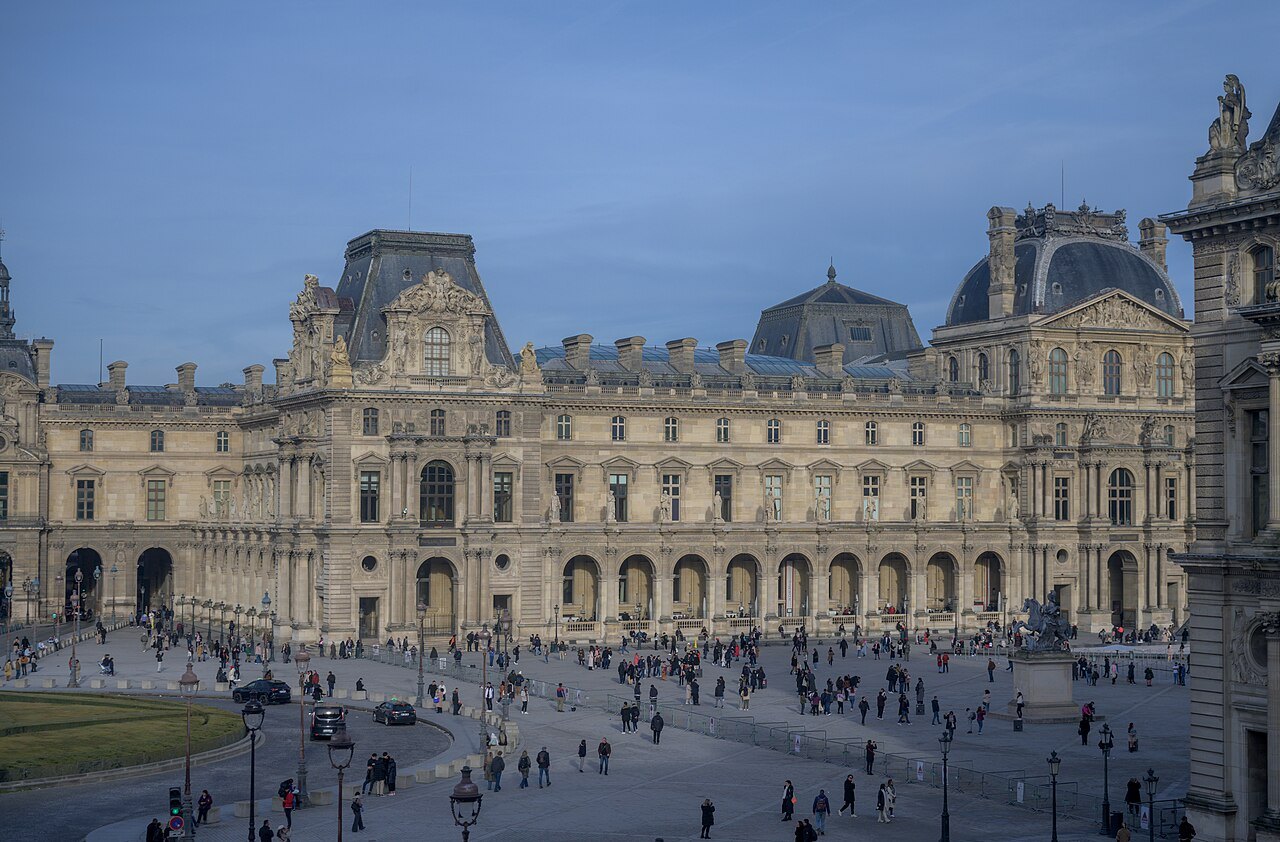
What you are looking at
The Louvre
1st
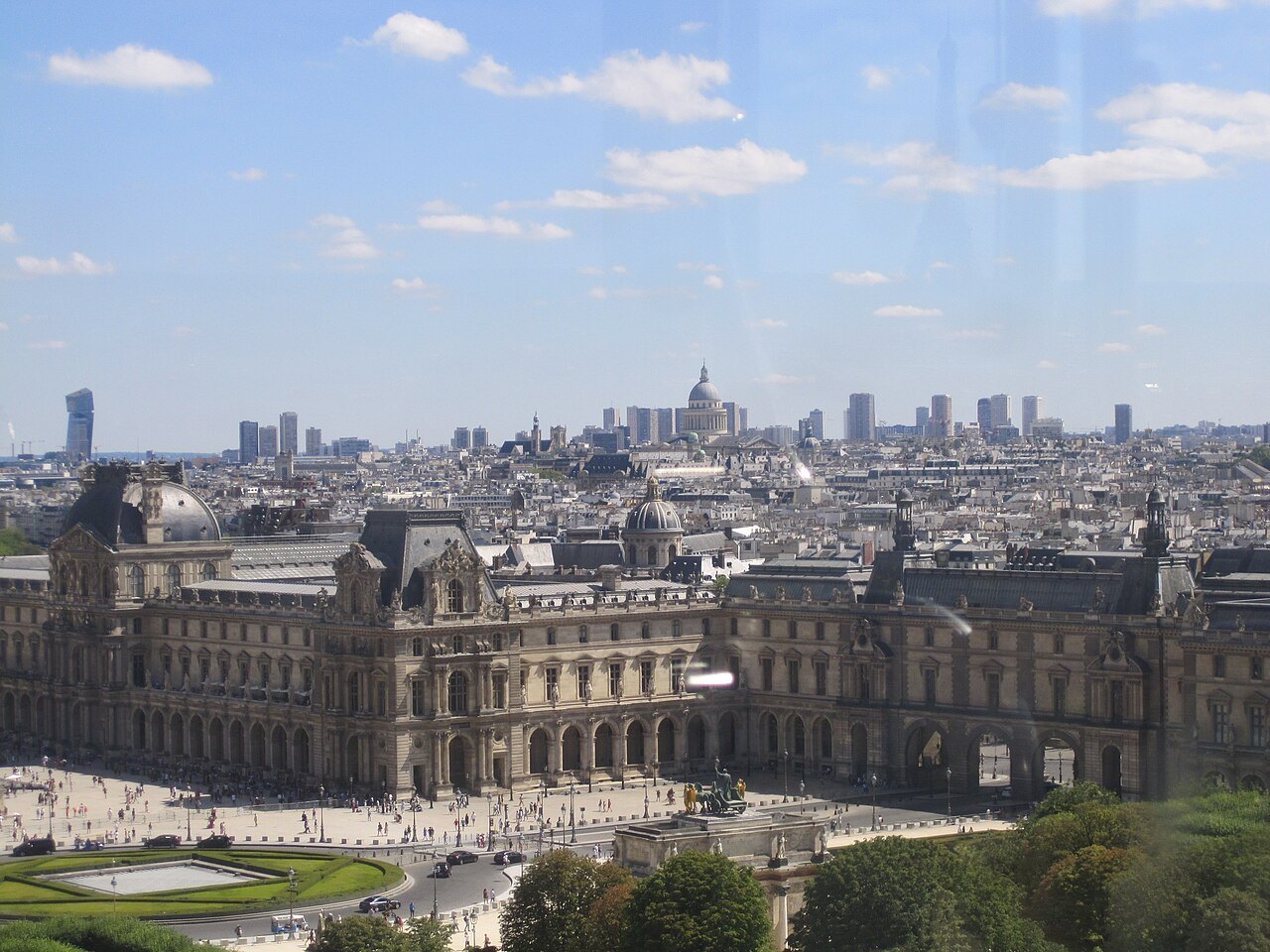
- 1The pyramidGlass and steel, 71 feet high, finished in 1989; the main entrance to the museum below.
- 2The Cour CarréeThe square Renaissance courtyard at the east end, the oldest part of the palace above ground.
- 3The medieval moatThe foundations of Philip Augustus's fortress, uncovered in the 1980s, in the basement of the Sully wing.
- 4The Denon wingThe long gallery along the Seine, with Italian painting, the Mona Lisa and the Winged Victory.
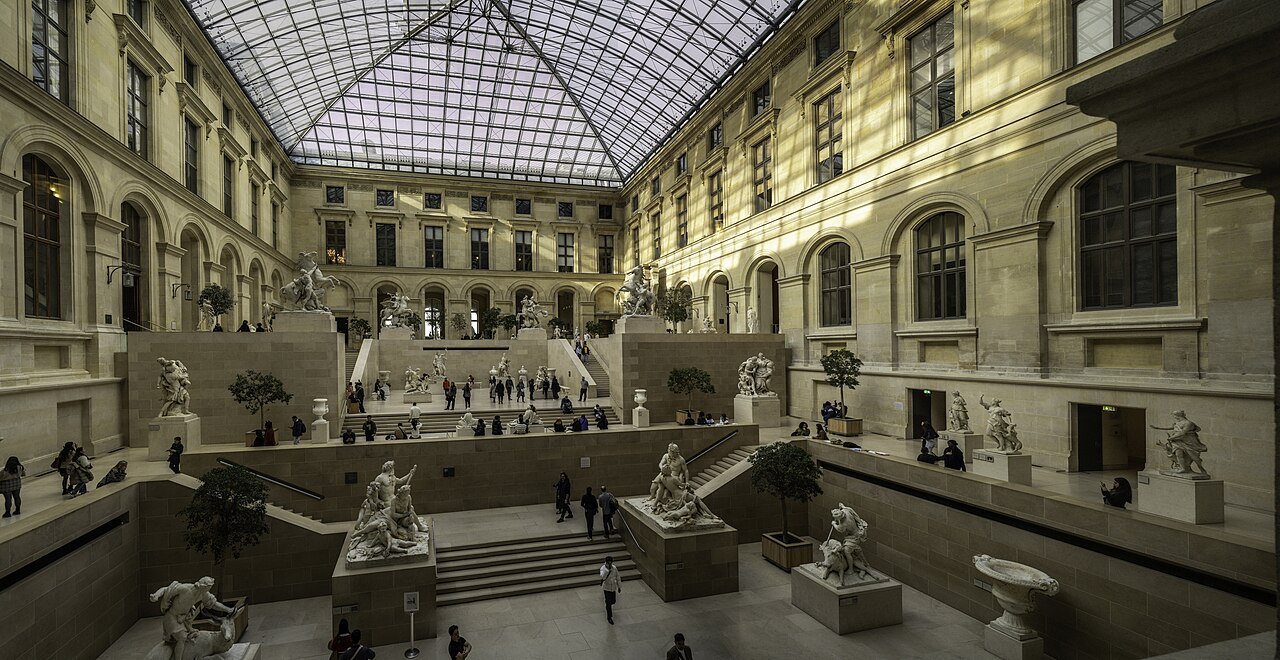
- 5The Richelieu wingThe former finance ministry, opened to the museum in 1993, with its glass-roofed sculpture courts.
The sight in full
Reading the place
Why it matters
The Louvre is the national art museum of France and the largest museum in the world, and in 2025 it received about nine million visitors, more than any other. It fills most of the Louvre Palace, on the Right Bank of the Seine in the 1st arrondissement, which grew over six centuries from a riverside fortress into a palace whose wings run half a mile west toward the Tuileries Garden.
Inside are some of the most famous works of Western art, the Mona Lisa, the Venus de Milo and the Winged Victory of Samothrace among them, and a great deal more: the museum displays about 35,000 works in eight departments, from ancient Egypt, Greece and Rome to Islamic art, decorative arts and European painting to the middle of the nineteenth century.
Fortress, palace, museum
The first Louvre was a fortress, built in the late twelfth century under King Philip II, known as Philip Augustus, to guard the western approach to Paris along the river. As the city grew past it, it lost its purpose, and in 1546 Francis I began turning it into the main residence of the French kings. For the next century and a half the palace was redesigned and extended by almost every reign.
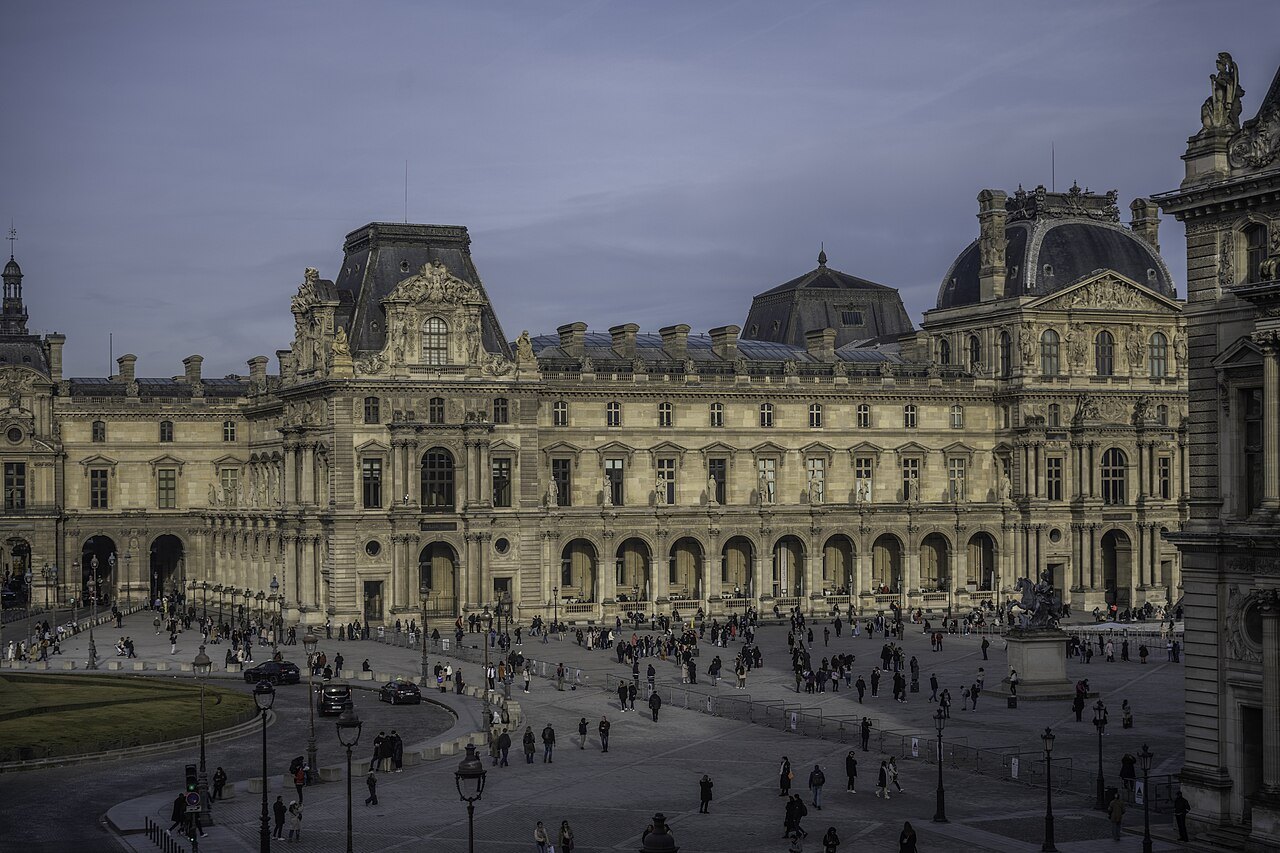
In 1682 Louis XIV moved his court to Versailles, and the Louvre became a home for the royal collections and the academies of art; from 1699 the painting academy held its salons here. The Revolution turned the palace into a public museum: it opened on 10 August 1793, the first anniversary of the fall of the monarchy, with 537 paintings, most of them from the royal collection or taken from the church.
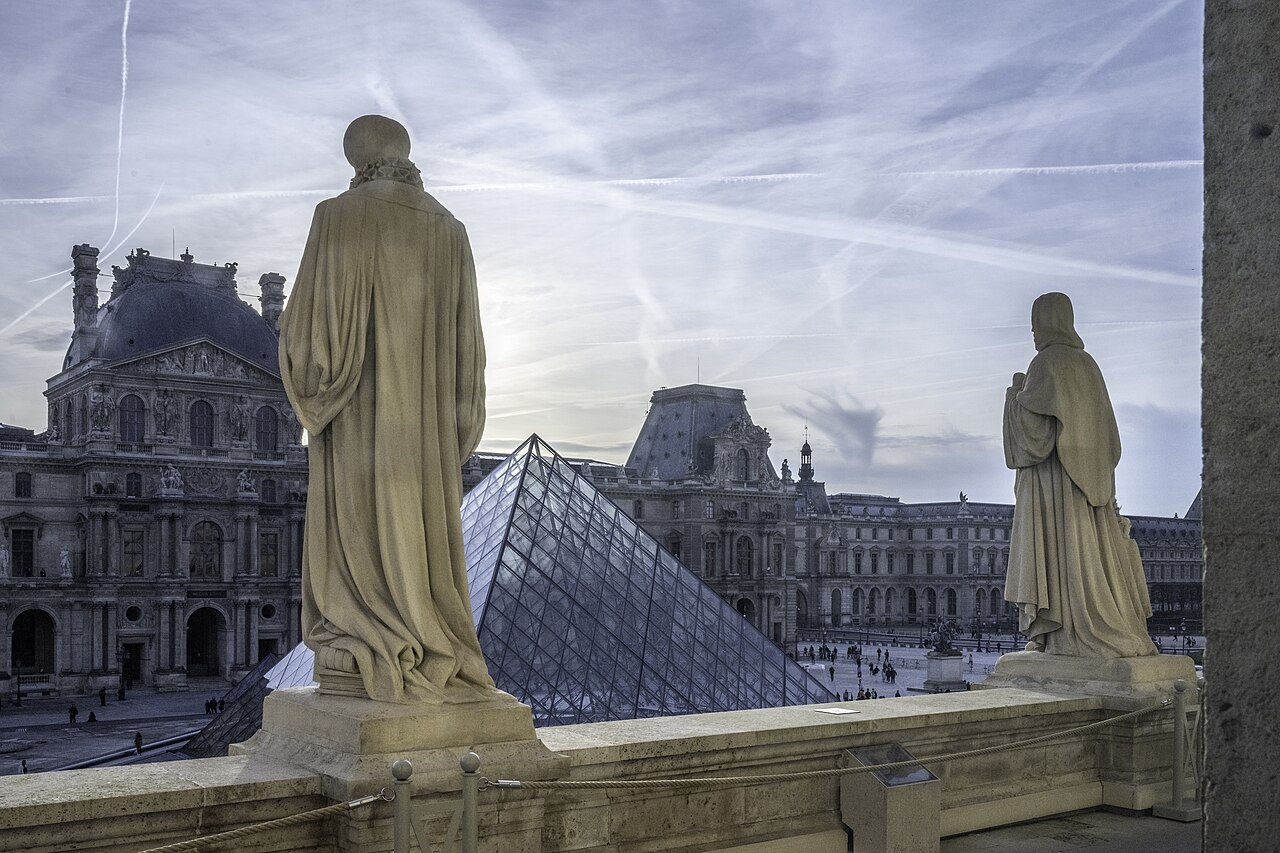
The last great change came in the 1980s. President François Mitterrand's Grand Louvre plan moved the finance ministry out of the north wing and gave almost the whole palace to the museum. Its architect, I. M. Pei, put a new entrance underground and marked it with a glass pyramid in the main courtyard, the Cour Napoléon. The pyramid's underground hall opened on 30 March 1989.
What you see: the palace
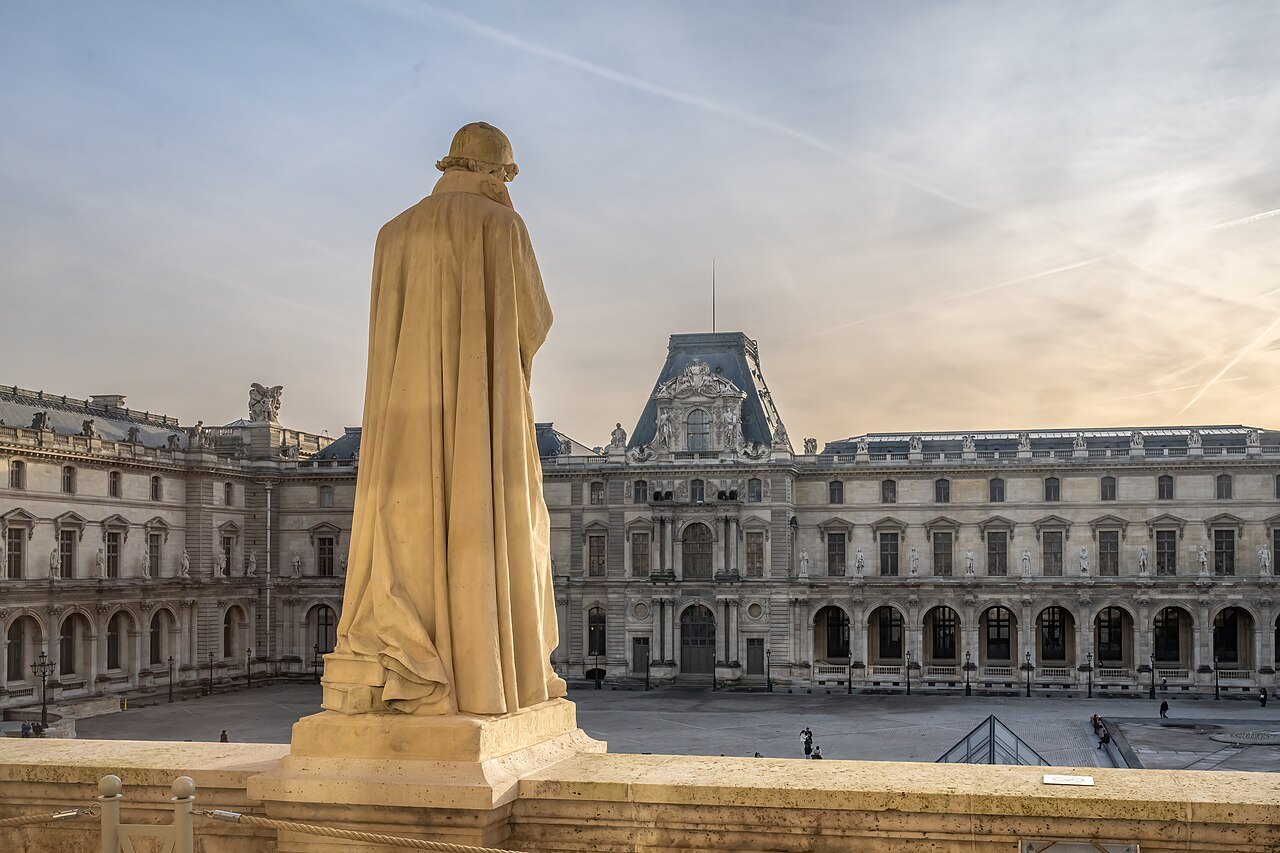
Before going in, walk the courtyards. The Cour Napoléon, with the pyramid and its fountains, is the wide space open to the west. East of it, through the archway of the Pavillon de l'Horloge, lies the Cour Carrée, the enclosed square courtyard of the Renaissance palace, quieter and more complete than the newer wings. Its eastern side is the Colonnade, the long classical front facing the church of Saint-Germain-l'Auxerrois.
The pyramid itself is 71 feet high, made entirely of glass panes on a frame of metal struts. It divided opinion when it was built and it still does, but it solved a real problem: the museum had several small street entrances, and the pyramid gave it one large hall, the Hall Napoléon, from which all three wings are reached.
What you see: the museum
The collections are arranged in three wings around the Cour Napoléon: Sully to the east around the Cour Carrée, Denon to the south along the river, and Richelieu to the north. On the mezzanine of Sully, rooms on the history of the palace lead down to the medieval Louvre: the dry moat and the foundations of Philip Augustus's fortress, uncovered during the Grand Louvre works. They are the oldest thing in the building.
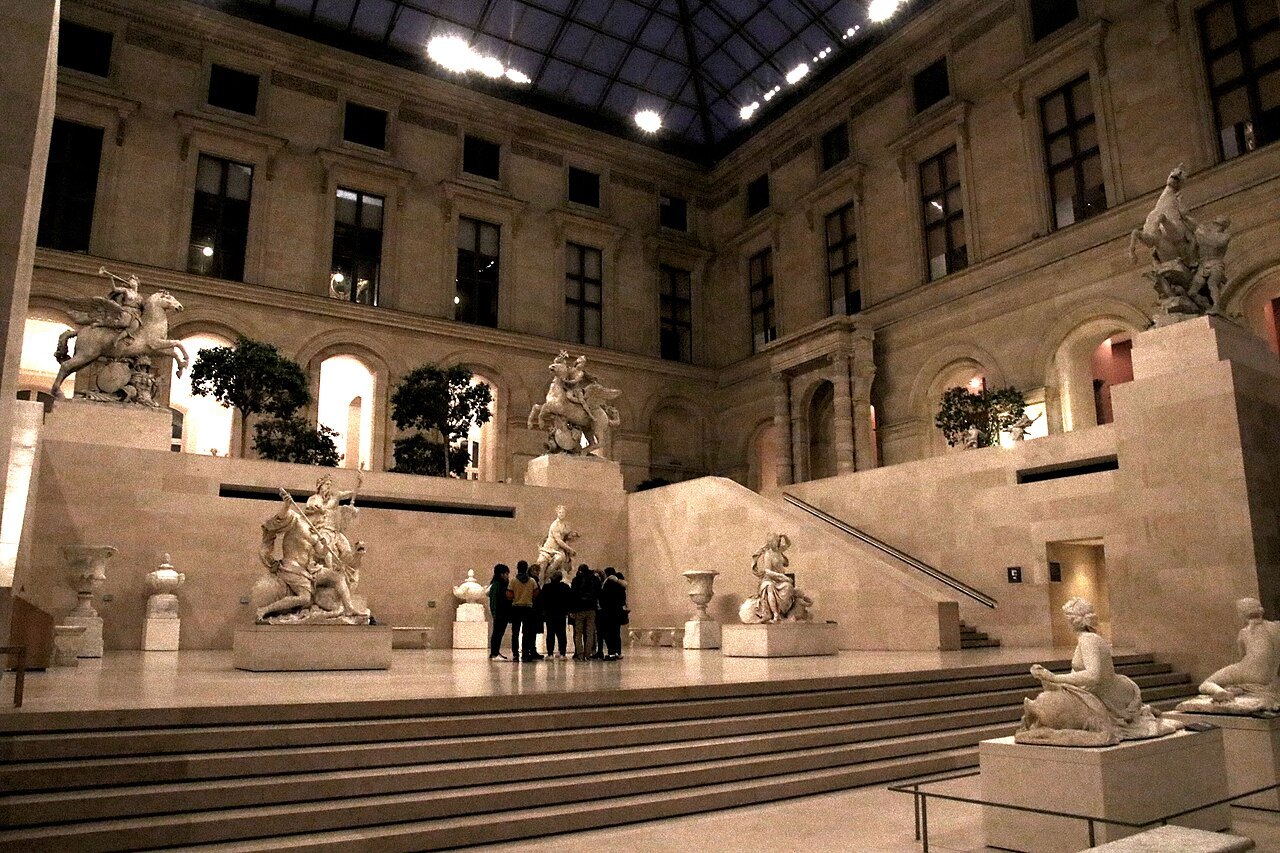
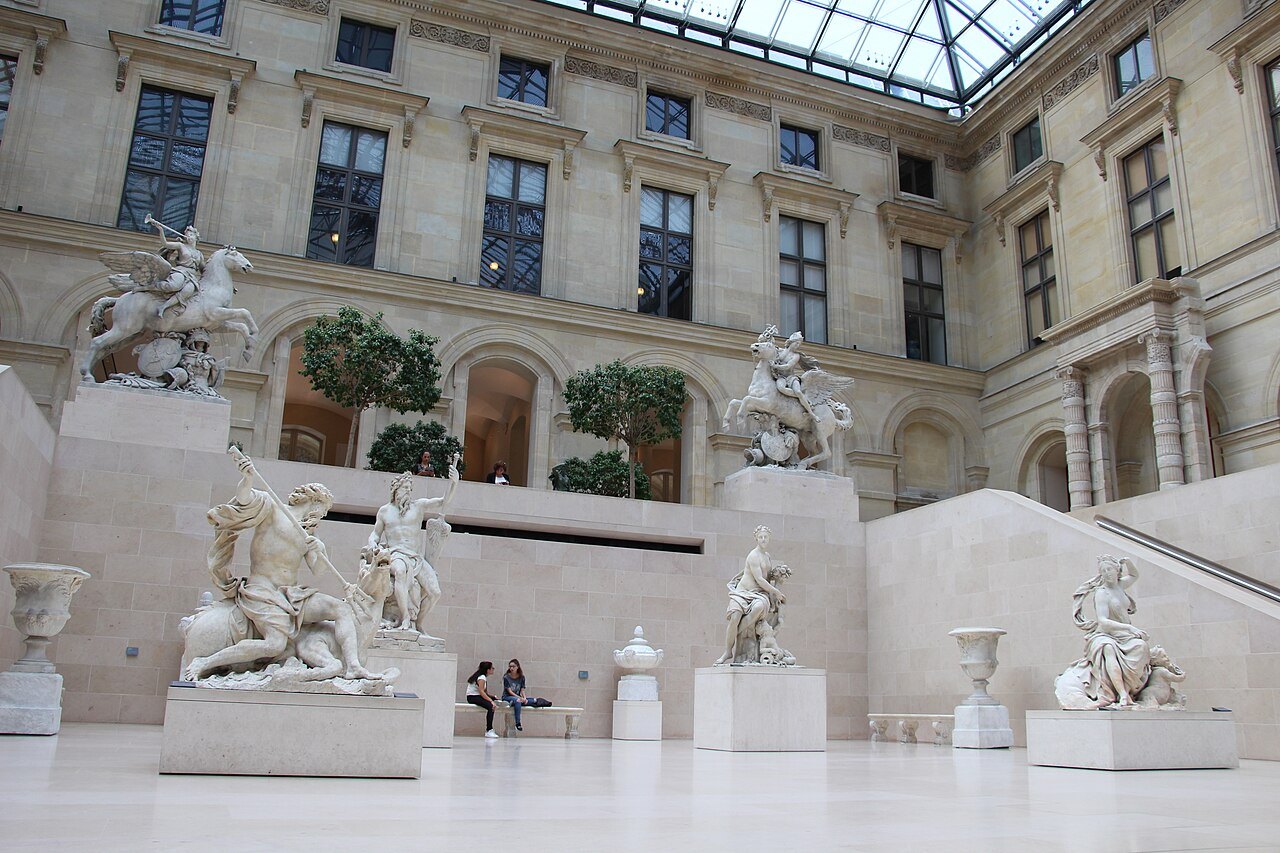
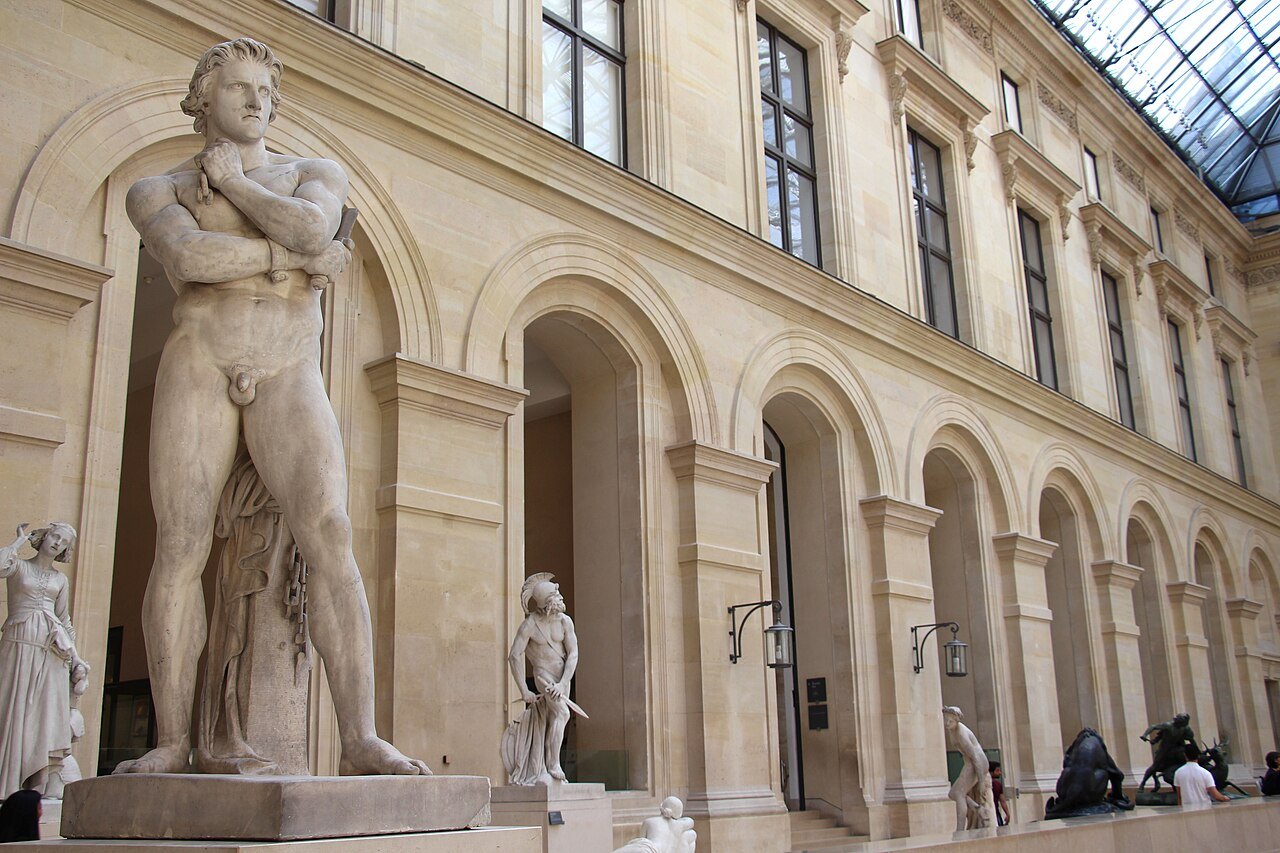
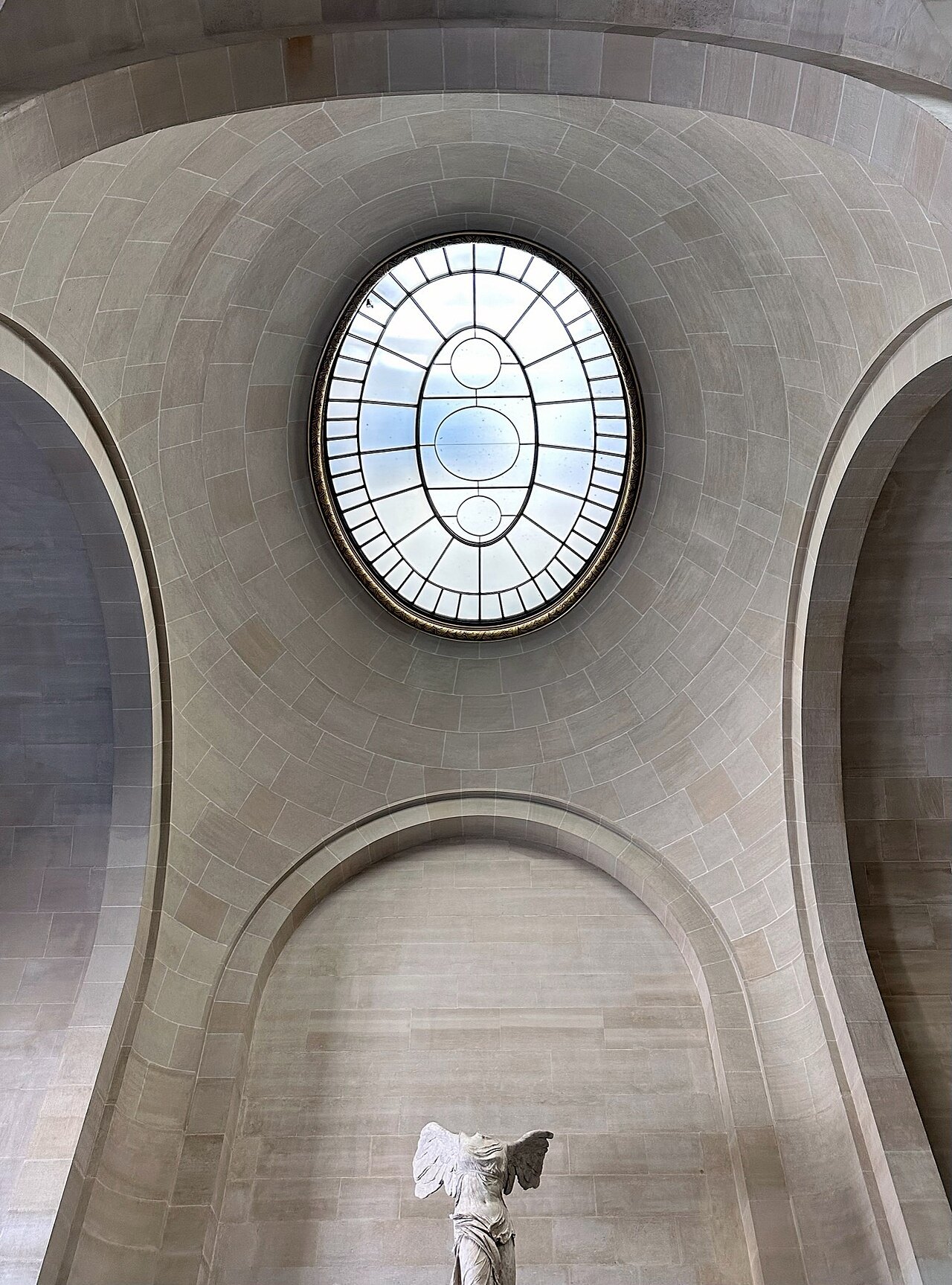
Denon holds the Italian paintings, the large French canvases of the early nineteenth century and the Mona Lisa, and at the head of the Daru staircase the Winged Victory of Samothrace, a Greek marble of a goddess landing on the prow of a ship. The Venus de Milo stands in the Greek sculpture galleries on the ground floor. Richelieu, opened in 1993 in the old ministry, has covered courtyards full of French sculpture under glass roofs, and the apartments of Napoleon III, preserved with their furniture and chandeliers.
Other works people cross the building for: Delacroix's Liberty Leading the People among the large French paintings in Denon; the Code of Hammurabi, the Babylonian law code carved on a black stone pillar, in the Near Eastern galleries of Richelieu; and the Seated Scribe, a painted Egyptian limestone figure with inlaid eyes, in Sully. On the first floor of Denon, the Galerie d'Apollon, a long gilded hall with a painted ceiling, first opened to the public with an exhibition of drawings in 1797.
How to visit
No one sees the Louvre in a day, and trying to is the most common mistake. Choose one wing, or three or four things you most want to see, and leave the rest for another visit. Two to three hours is a satisfying first visit; the galleries around the Mona Lisa are always the most crowded, so see it early in your visit or late, and spend the time you save in the emptier rooms of Sully and Richelieu.
The main entrance is through the pyramid. There is also an entrance underground from the Carrousel du Louvre shopping arcade, which connects directly to the Palais Royal–Musée du Louvre Métro station. Booking a time slot is recommended for every visitor, even those who enter free, and tickets are sold at the door only when the museum is quiet. Buy only from the museum's own ticket site, since fake sites selling tickets are common; see booking ahead. The Sainte-Chapelle is a short walk across the Pont Neuf.
Myths worth setting aside
The pyramid does not have 666 panes. The story began in the 1980s, when an official brochure printed during construction gave that number, and it has followed the building ever since. The museum's own count is 673: 603 diamond-shaped panes and 70 triangles.
Nor is the Mona Lisa the museum's only reason to exist, though it can feel that way in the Salle des États. It is a small painting behind glass across a crowded room, and many of the finest Italian paintings in the building hang in the long Grande Galerie a few steps away, where the crowd thins.
Where to go next
Nearby
- Nearby · 1st · 8thThe Tuileries, the Orangerie and the Place de la ConcordeA queen's palace garden of 1564, redrawn by Le Nôtre and opened to the public in 1667, running from the Louvre to the largest square in Paris, with Monet's Water Lilies on its western terrace.Read the page →
- Nearby · Île de la CitéThe Sainte-Chapelle and the ConciergerieWhat is left of the kings' palace on the island: a chapel of 1248 whose upper walls are almost all stained glass, and the Gothic halls below the courthouse where the Revolution held its prisoners.Read the page →
- Nearby · 7thThe Musée d'OrsayA Beaux-Arts railway station built for the exposition of 1900 and opened as a museum in 1986, holding the largest collection of Impressionist and Post-Impressionist painting in the world.Read the page →