SCIENCE UNDER THE DOME
What did Foucault's pendulum prove in the Panthéon?
How a swinging sphere hung in the Panthéon's dome once demonstrated that the Earth itself turns.
The answer in full
Read on
What Foucault's Pendulum Proved
In 1851 the physicist Léon Foucault suspended a heavy sphere from the dome of the Panthéon on a wire about two hundred twenty feet long, turning the building into a laboratory. The pendulum swung back and forth for hours, and as it did, the line of its swing appeared to drift slowly around a circle traced on the floor below. Foucault set out to show, without looking at the sky, that the Earth itself turns.
A pendulum left to swing freely keeps swinging in the same plane relative to the distant stars, unless something pushes it sideways. Nothing in the Panthéon pushes Foucault's pendulum sideways. Watchers on the floor, however, are standing on a planet that turns underneath the pendulum once a day, so from their point of view it is the floor, not the pendulum, that is doing the moving, and the line of the swing that appears to rotate.
At the pole this drift would complete a full turn in a day; in Paris it takes longer, because only part of the Earth's spin acts on the pendulum. Foucault needed no telescope or star chart to make his point: a wire, a sphere, and a dome were enough to make an abstract fact about the solar system visible to anyone standing in the nave.
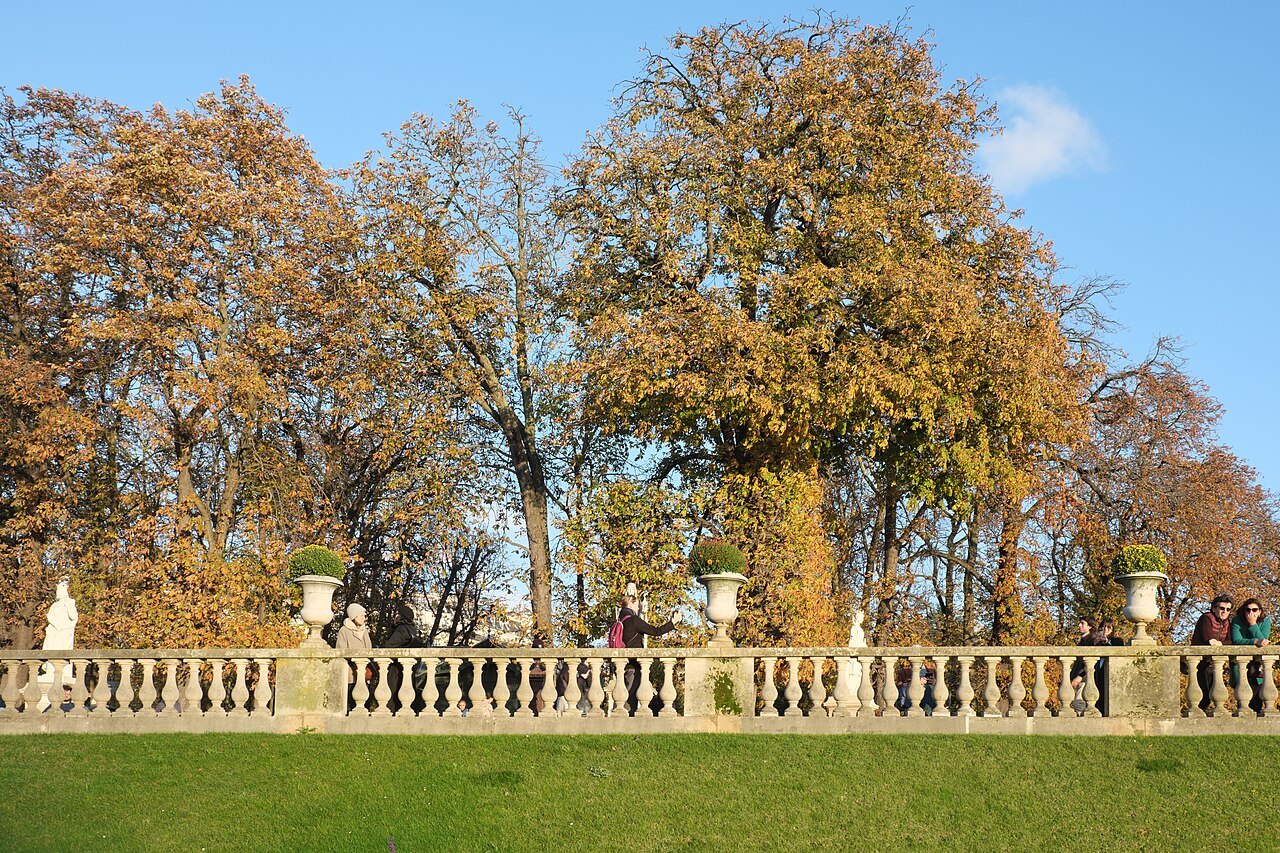
The sphere hanging in the Panthéon today is a copy; the original pendulum that Foucault used is kept at the Musée des Arts et Métiers, elsewhere in Paris. It hangs at the crossing of Soufflot's Greek-cross plan, directly beneath the highest point of the dome, a short walk from the Luxembourg Gardens at the foot of the Rue Soufflot in the 5th arrondissement.
The Dome That Makes It Possible
The pendulum needs height and a fixed point from which to hang, and the Panthéon's dome supplies both. Seen from outside, the dome rises two hundred seventy-two feet above the street, built entirely of stone rather than the timber frame used under the dome of Les Invalides across the river. It is in fact three domes, one set inside another, each with a different job.
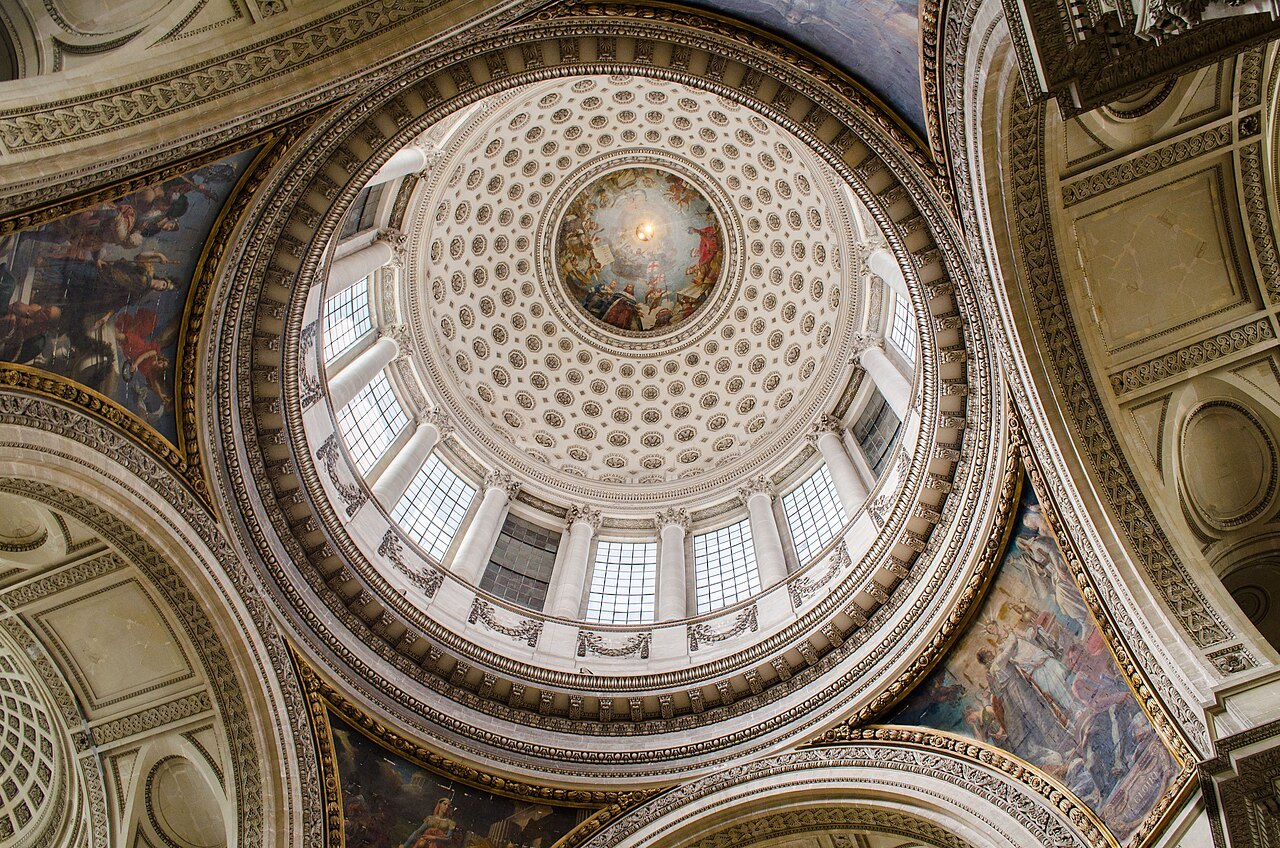
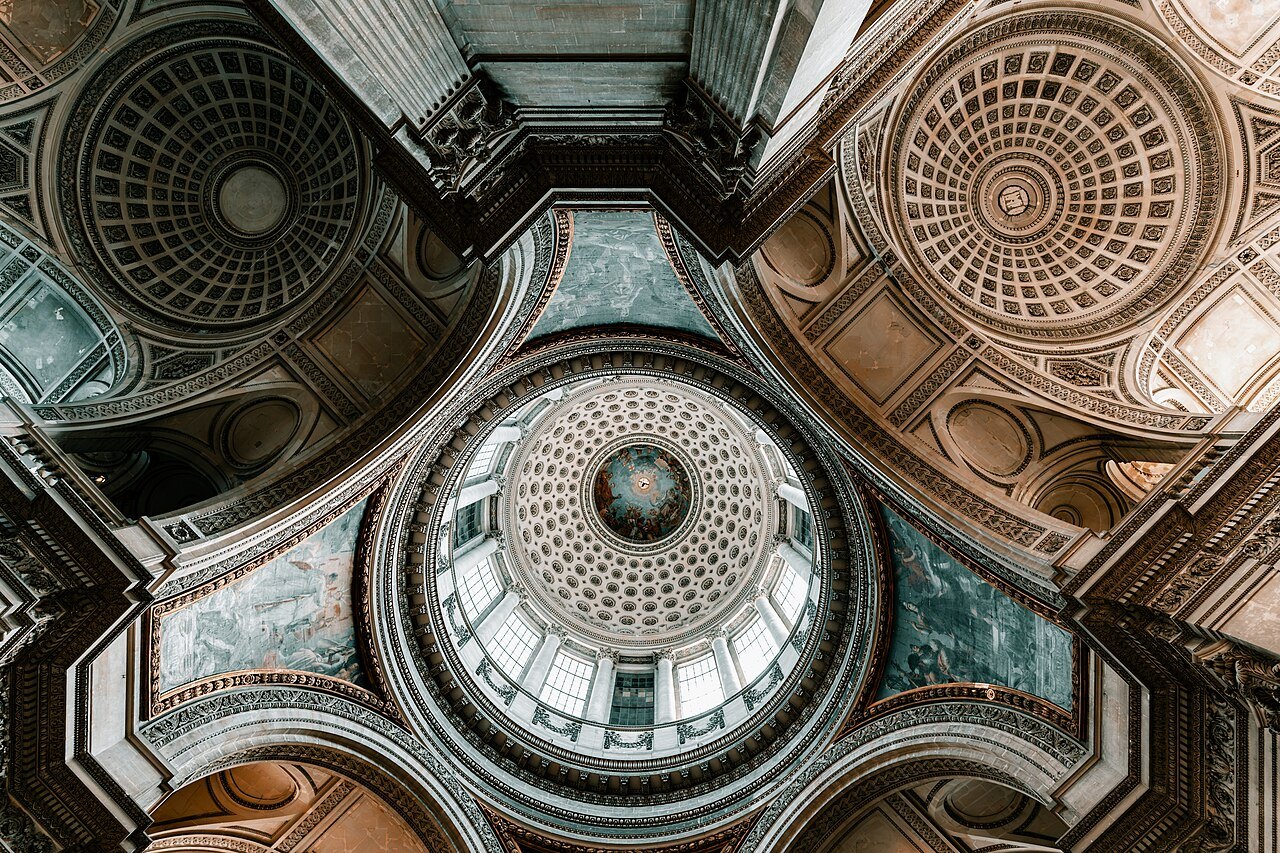
The lowest dome is coffered stone, opened at its center by a round oculus that rests on the drum above the outer colonnade; through that opening visitors can see Antoine-Jean Gros's painting of the apotheosis of Saint Genevieve on the dome above it. A third, hidden dome between the two does the structural work, while the outermost dome, covered in bands of lead, carries the lantern and the cross.
Foucault's wire runs down through the opening at the crossing, where the four arms of Soufflot's Greek-cross plan meet. The pendulum's slow swing, the carved stone far above it, and the painted saint overhead make the crossing the one place in the building where its two centuries of purpose, church and scientific stage, sit directly on top of each other.
From a King's Vow to a National Mausoleum
Louis XV vowed to rebuild the old abbey church of Saint Genevieve, patron saint of Paris, after recovering from a grave illness, and commissioned Jacques-Germain Soufflot to design it. Soufflot wanted the lightness of a Gothic cathedral combined with the columns and proportions of classical architecture, and drew the building as a Greek cross with a great dome over the crossing. Neither he nor the king lived to see it finished.
Construction ran from 1758 to 1790, and by the time it was complete the Revolution had begun. In 1791 the National Constituent Assembly voted to turn the church into a mausoleum for distinguished citizens, on the model of the Pantheon in Rome. The orator Mirabeau was the first buried there, though his remains were later removed, and some windows were walled up to darken the interior.
The building changed hands twice more in the nineteenth century, returned to the church and reclaimed as a mausoleum as each regime altered the pediment and the top of the dome to suit itself. Victor Hugo's funeral in 1885, and his burial in the crypt, settled the question for good; the Third Republic had already decreed in 1881 that the building would be a mausoleum only.
The Walls and the Crypt Below
Around the nave, large late-nineteenth-century paintings tell the life of Saint Genevieve, said to have protected Paris from Attila, alongside scenes from French history including Joan of Arc. The murals by Pierre Puvis de Chavannes are the best known for their pale, calm style. At the east end, where Soufflot had planned an altar, stands François Sicard's monument to the Revolution's National Convention, finished in 1920.
The crypt runs beneath the whole building in bare, vaulted galleries opening into small cells of tombs; burial here requires an act of parliament. Among those entombed are the philosophers Voltaire and Rousseau, novelists Victor Hugo and Émile Zola, Louis Braille, inventor of the reading system for the blind, the socialist leader Jean Jaurès, Resistance leader Jean Moulin, Marie and Pierre Curie, and Soufflot himself, moved here in 1829.
Marie Curie, buried in 1995, was the first woman honored here on her own merit; the singer and Resistance agent Josephine Baker followed in 2021. More recent burials show how the idea of greatness has widened further: the Resistance figures Geneviève de Gaulle-Anthonioz and Germaine Tillion arrived in 2015, Simone Veil in 2018 beside her husband, and novelist Alexandre Dumas in 2002.
How to Visit
An hour is enough to see the nave, the pendulum, and the crypt; allow more time to read the names in each vault. The square in front of the Panthéon makes a good starting point for a walk through the Latin Quarter, and the Luxembourg Gardens lie a few minutes downhill at the bottom of the Rue Soufflot.
The Panthéon is run by the national monuments agency that also manages the Sainte-Chapelle and the Arc de Triomphe; its own website carries the details that change by day, including anything affecting access to the dome or crypt. For monuments that sell timed tickets, check the general guidance on booking ahead.
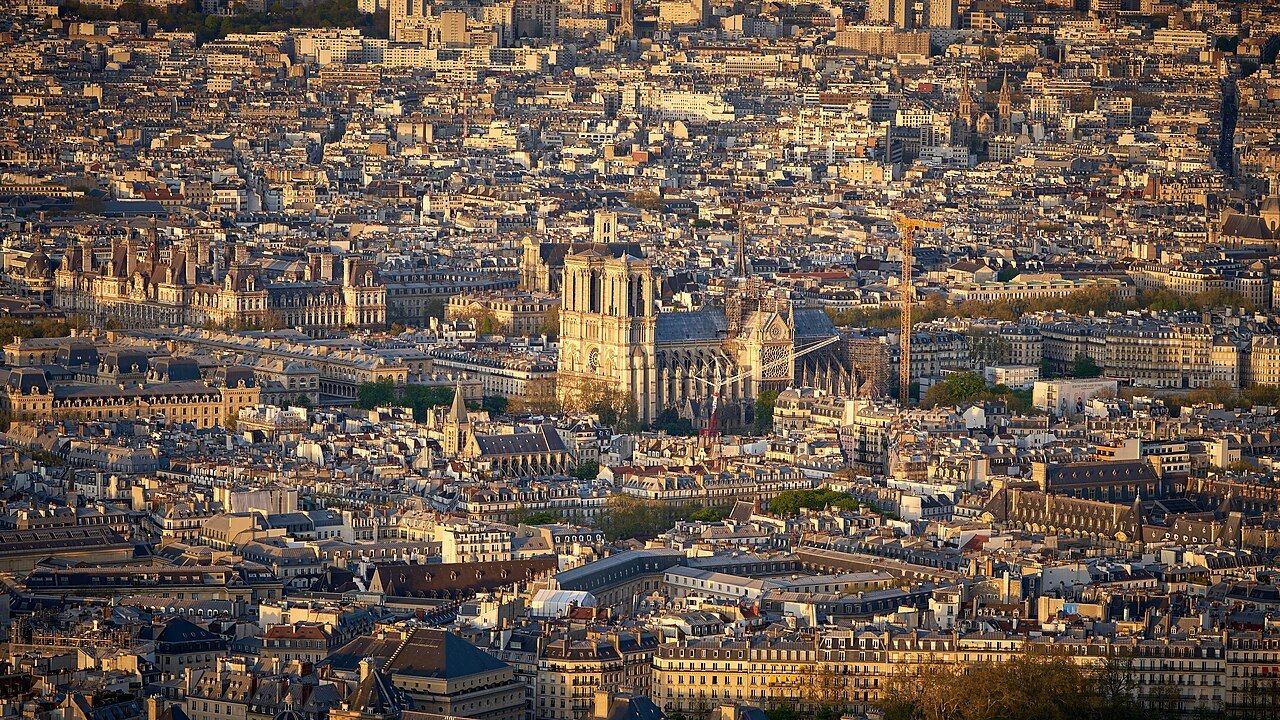
From the steps of the Panthéon, the view runs straight down the Rue Soufflot toward the gardens at the bottom of the hill. The building stands on the Montagne Sainte-Geneviève, the high ground of the Latin Quarter, so the final approach on foot is uphill whichever direction a visitor arrives from.
Myths Worth Setting Aside
Voltaire's remains were not stolen. A story spread that religious fanatics removed his bones from the crypt in 1814 and dumped them on a rubbish heap; the rumor grew for decades until his coffin was opened in 1897 and he was found still inside it, exactly where he had been placed.
The Panthéon was also never meant as a copy of the Pantheon in Rome. Soufflot designed a church for Saint Genevieve; only the name, and the later idea of honoring the dead inside it, came from Rome. The pendulum, added more than sixty years after the building opened, has nothing to do with either Pantheon's origin.
The pendulum does not prove that the Earth orbits the sun, only that it spins on its axis; the two are different motions, and Foucault's experiment addresses only the second. Visitors sometimes expect the swing to trace a full circle while they watch; at the latitude of Paris the drift is visible only as a slow change in direction over the course of an hour or more.
Read next
More from the journal
- The PanthéonWho is buried in the crypt of the Panthéon?Voltaire, the Curies, Victor Hugo, and more: who France has chosen to bury in the Panthéon's crypt, and why.Read the piece →
- The Place des Vosges and the MaraisWhere did Victor Hugo live on the Place des Vosges?Where Victor Hugo's apartment stood on the Place des Vosges, and what the house at number six holds today.Read the piece →
- The Musée d'OrsayHow did a railway station become the Musée d'Orsay?How a Belle Époque railway terminus on the Seine became the world's great home of Impressionist painting.Read the piece →