THE PALACE THAT DISAPPEARED
What happened to the Tuileries Palace?
How Catherine de' Medici's palace became the Tuileries Garden, and what still stands where it burned in 1871.
The answer in full
Read on
A palace that vanished
The Tuileries Garden is the long formal garden between the Louvre and the Place de la Concorde, in the first arrondissement: sixty-three acres of gravel walks, clipped trees, pools, and statues. It was laid out as the garden of a palace, and for more than three centuries it has been a place where Parisians walk, sit, and watch the city pass.
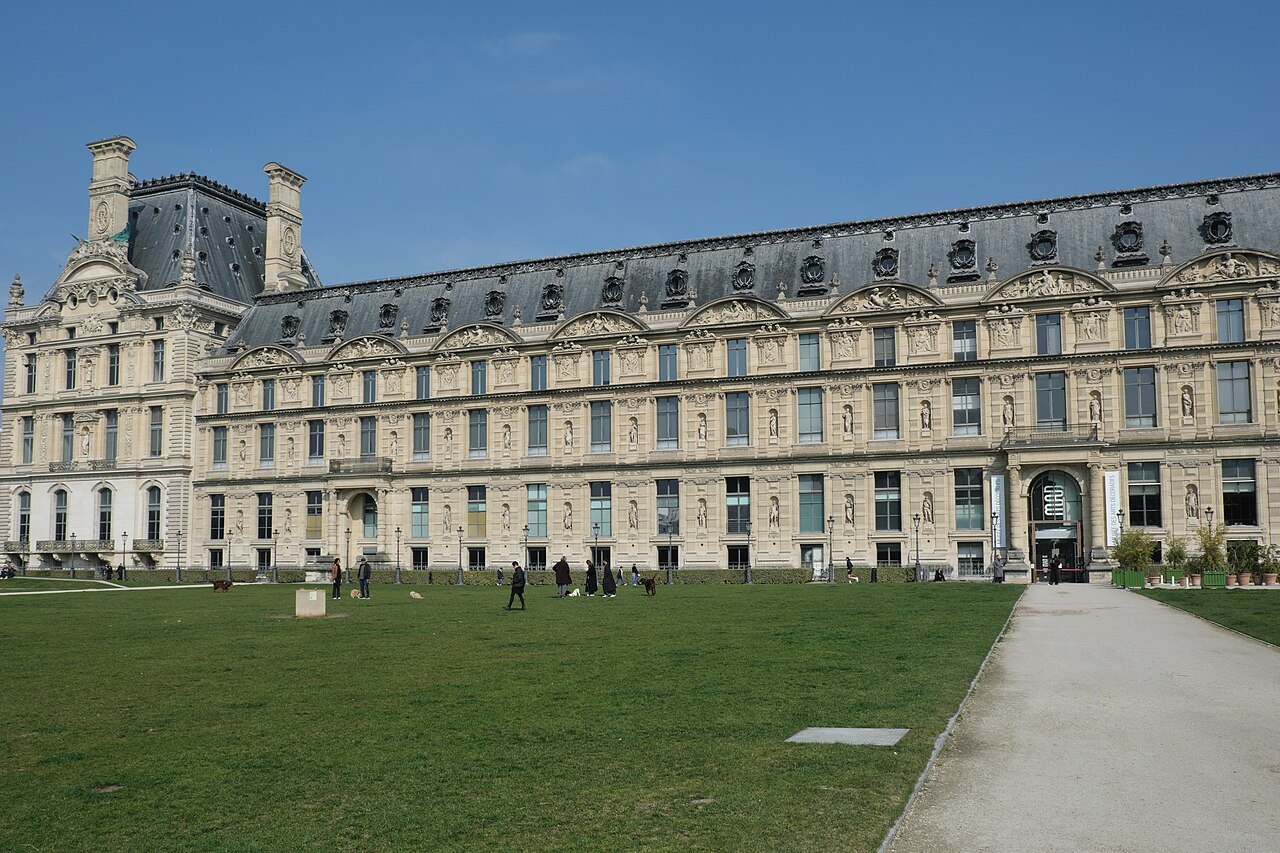
That palace is gone. It burned in 1871 during the Commune, and its ruins were cleared away in the 1880s. What remains is the garden it once fronted, running in an unbroken line from the courtyard of the Louvre to the obelisk of the Place de la Concorde and on toward the Arc de Triomphe.
Because the palace disappeared and the space was left open, the garden now reads as one continuous vista rather than a backdrop to a building. That emptiness at its eastern end is itself the clue to what happened here, and the rest of this page follows the story from the palace's founding to its destruction.
Catherine de' Medici's garden, and Le Nôtre's redesign
In 1564 Catherine de' Medici, widow of Henry the Second, began building a new palace west of the Louvre, on ground that had belonged to tile makers, the tuileries that gave the place its name. She laid out an Italian-style garden in front of it, the first version of what visitors walk through today.
A century later, in 1664, Louis the Fourteenth's minister Colbert commissioned the landscape architect André Le Nôtre to redesign the whole garden. Le Nôtre's own grandfather had worked as one of Catherine's gardeners here. He gave the Tuileries the form it still keeps: a central axis running west, broad terraces along the sides, and formal pools at either end.
The garden opened to the public in 1667, decades before the French Revolution, making it one of the oldest public gardens in the city. The palace that it served stood until 1871; after the fire and the clearance of the ruins, the garden simply ran on into the Louvre's open courtyard, which is why the sightline today carries straight through from one end to the other.
Walking the garden today
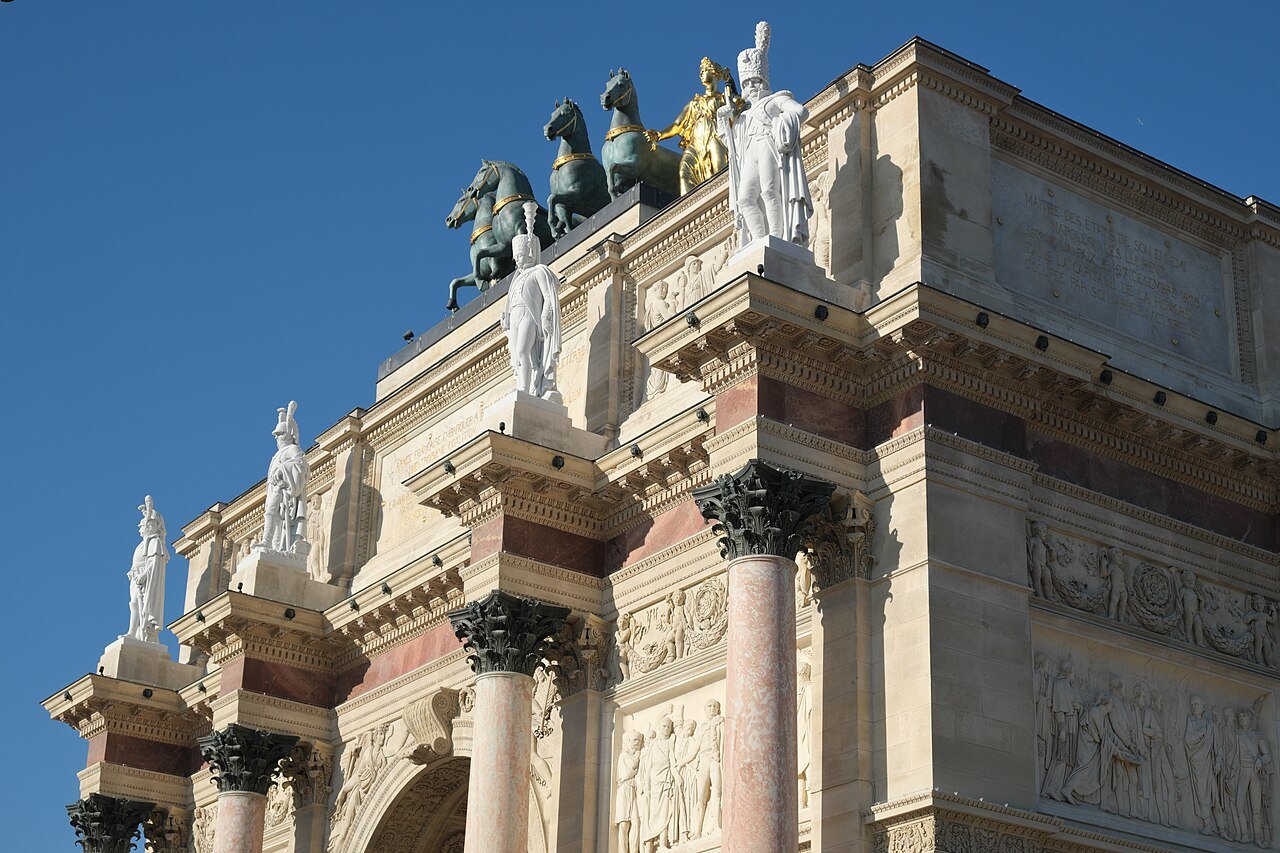
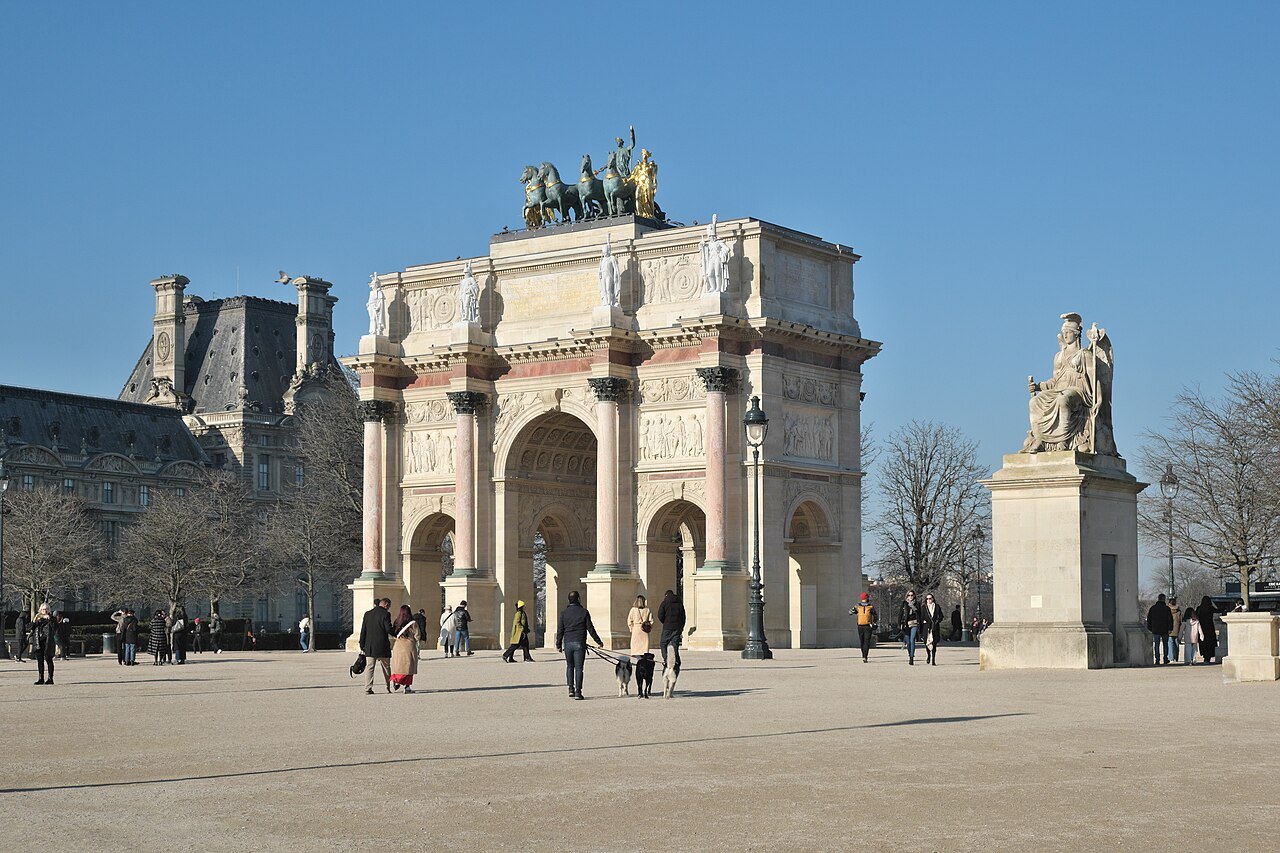
Entering from the Louvre end, visitors pass beneath the small Arc de Triomphe du Carrousel, built in imitation of a Roman triumphal arch, before the Grande Allée opens out ahead. Near the Louvre sits a round pool with its fountain and ring of metal chairs; at the garden's far end is a larger octagonal pool, a favorite spot for a rest and for children sailing model boats.
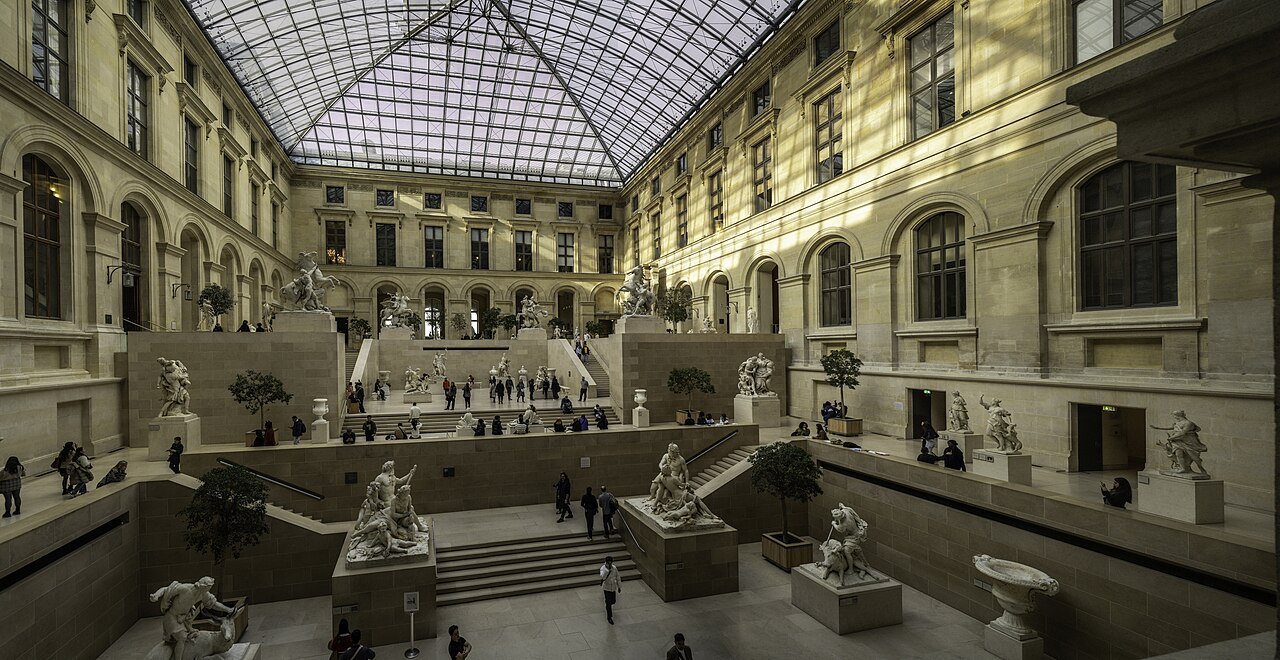
The statues ringing the octagonal pool represent the seasons and figures from ancient Rome, though these are copies: the originals, like much of the garden's older sculpture, are kept inside the Louvre. In 1964 the culture minister André Malraux introduced modern sculpture to the garden, starting with Aristide Maillol's bronze figures in the Carrousel section.
More recent works by international sculptors now stand among the trees flanking the Grande Allée. At the garden's western end, two horseshoe-shaped ramps climb to terraces overlooking the Place de la Concorde, and the terrace running along the Seine offers one of the most pleasant stretches of walking in the center of Paris.
The Orangerie and Monet's Water Lilies
At the garden's western edge, on a terrace above the square, stands the Musée de l'Orangerie. It was built in 1852, under Napoleon the Third, as a shelter to keep the palace's citrus trees through winter. After the First World War the building passed to the fine arts administration, setting it on course for a very different use.
The prime minister Georges Clemenceau, a friend of Claude Monet, pushed for Monet's large water-lily paintings to be housed here; the gift was settled in 1922. Monet worked directly with the architect on the installation: eight panels, each roughly six and a half feet high and almost three hundred feet long in total, wrap around two oval rooms lit from above, their floor plan forming the shape of an infinity sign.
Downstairs, the museum holds the Walter-Guillaume collection, with paintings by Cézanne, Renoir, Matisse, Modigliani, Picasso, Rousseau, and Soutine. Outside on the terrace stand four sculptures by Rodin, including The Kiss; for a fuller look at his work, see the Rodin museum. On the opposite terrace, toward the Rue de Rivoli, the Jeu de Paume shows changing exhibitions of photography and contemporary art.
The Place de la Concorde
Beyond the Orangerie's terrace lies the Place de la Concorde, the largest square in Paris. It was laid out for Louis the Fifteenth and originally named for him, with an equestrian statue at its center. In 1792 the statue came down, the square was renamed Place de la Révolution, and a guillotine was installed on its surface.
Louis the Sixteenth was executed here on the twenty-first of January, 1793, and Marie Antoinette that October. In 1795 the square was renamed Place de la Concorde, a deliberate gesture of reconciliation after the violence of the preceding years.
At its center now stands the Luxor obelisk, a column of yellow granite about seventy-five feet tall, carved with hieroglyphs praising Ramesses the Second; it was raised on the old statue's pedestal in 1836, with the engineering of that operation illustrated on its base. On either side, the architect Jacques Ignace Hittorff built two fountains, one honoring the seas and one the rivers of France; the northern fountain stands roughly where the guillotine once stood.
Planning the visit
The garden itself is free to walk through and makes a natural link between the Louvre and the rest of the Right Bank. Allow about half an hour to cross it at an easy pace, longer if the pools and terraces invite a longer stop.
The Orangerie is compact enough to see thoroughly within an hour, and tends to be quietest early in the day; check its own website for current hours and for whether a timed entry applies, and see booking ahead for general guidance on reserving slots at Paris museums.
The Place de la Concorde functions as a large traffic circle, so the obelisk is best viewed from the pedestrian crossings on its eastern side, with the garden gates at one's back. From there, the Grand Palais and the Pont Alexandre III are a short walk west along the river; for transit details to reach the area, see getting around.
Myths worth setting aside
The garden's name has nothing to do with a person or a family. The tuileries were simply the tile kilns that stood on this land before Catherine de' Medici built her palace, and the name stuck to the site long after the kilns were gone.
The Luxor obelisk is also widely misunderstood. It did not arrive in France as war booty. It was a diplomatic gift from Muhammad Ali, the ruler of Egypt, offered in 1829 as one of a matched pair; the second obelisk proved too heavy to move with the technology of the time and stayed in Egypt.
In 1981, President François Mitterrand formally returned France's claim to that second obelisk, closing a chapter that had lasted more than a century. Visitors standing before the one in the Concorde today are looking at a gift, not a trophy, raised by French engineers in 1836 using methods recorded on its own base.
Read next
More from the journal
- The LouvreWhy did the glass pyramid at the Louvre cause such a fight?How I. M. Pei's glass pyramid divided opinion at the Louvre, and what problem it actually solved.Read the piece →
- The LouvreHow do you see the Louvre in a single day?A practical one-day plan for choosing what to see at the world's largest museum.Read the piece →
- The Sainte-Chapelle and the ConciergerieWho was held in the Conciergerie during the Revolution?Marie Antoinette and thousands of others passed through the Conciergerie's halls before the guillotine.Read the piece →