THE WHITE DOME OF MONTMARTRE
Why is Sacré-Cœur so white?
The chemistry behind Sacré-Cœur's bright white stone, and the history and controversy that built the basilica.
The answer in full
Read on
The Stone That Cleans Itself
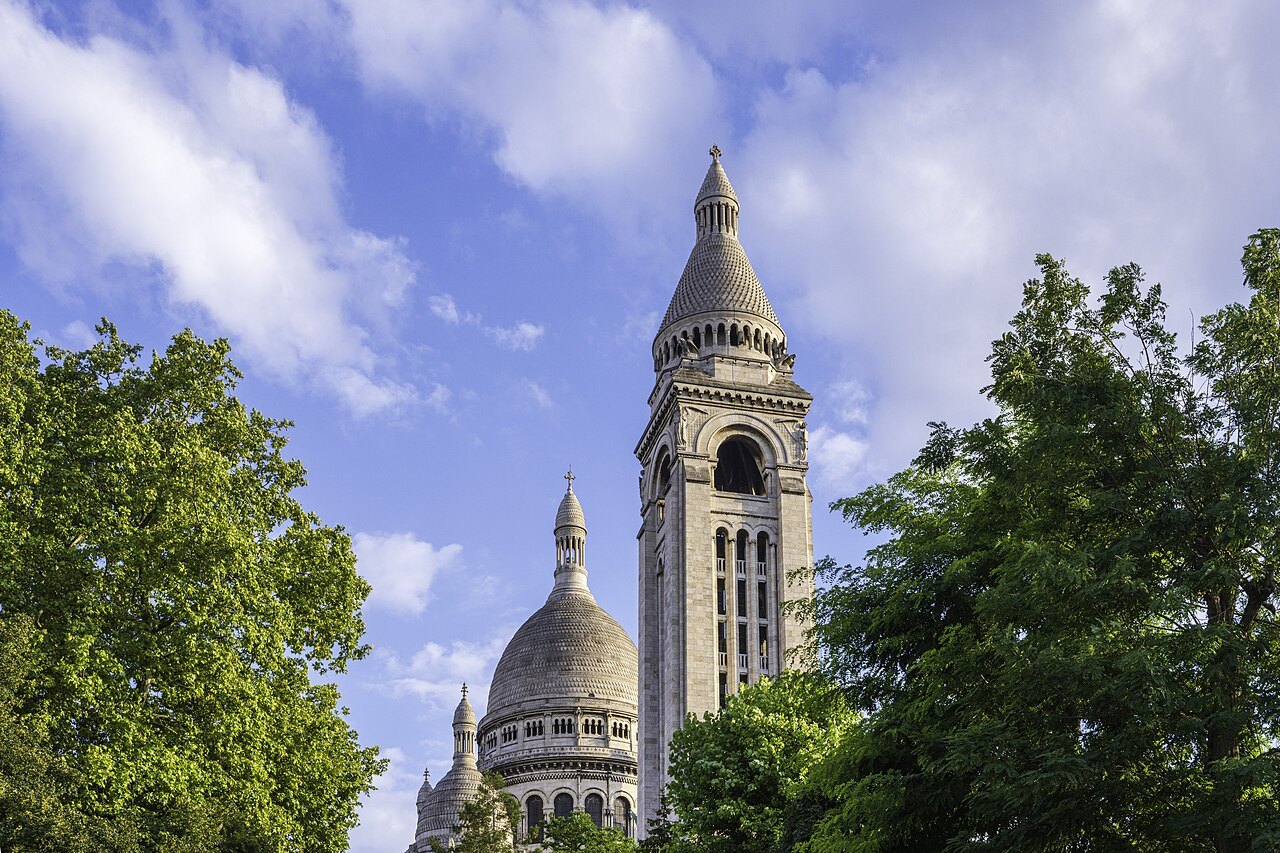
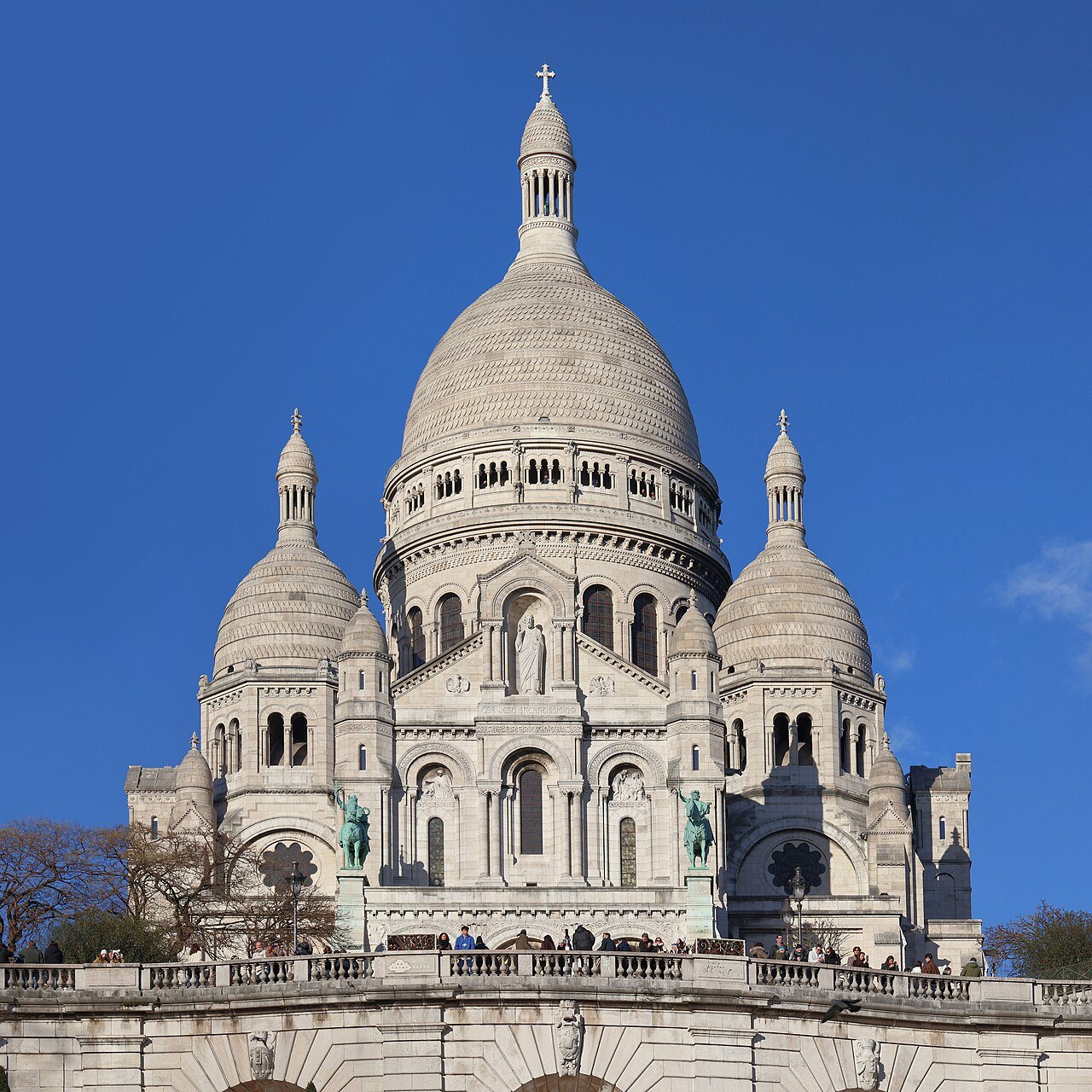
The basilica's brilliant white does not come from scrubbing or paint. Paul Abadie, the architect who won the competition for Sacré-Cœur, chose a pale travertine limestone quarried south of Paris, a stone that is extremely hard and releases calcite whenever rain falls on it. That calcite settles on the surface like a natural whitewash, so each shower leaves the walls paler rather than dirtier.
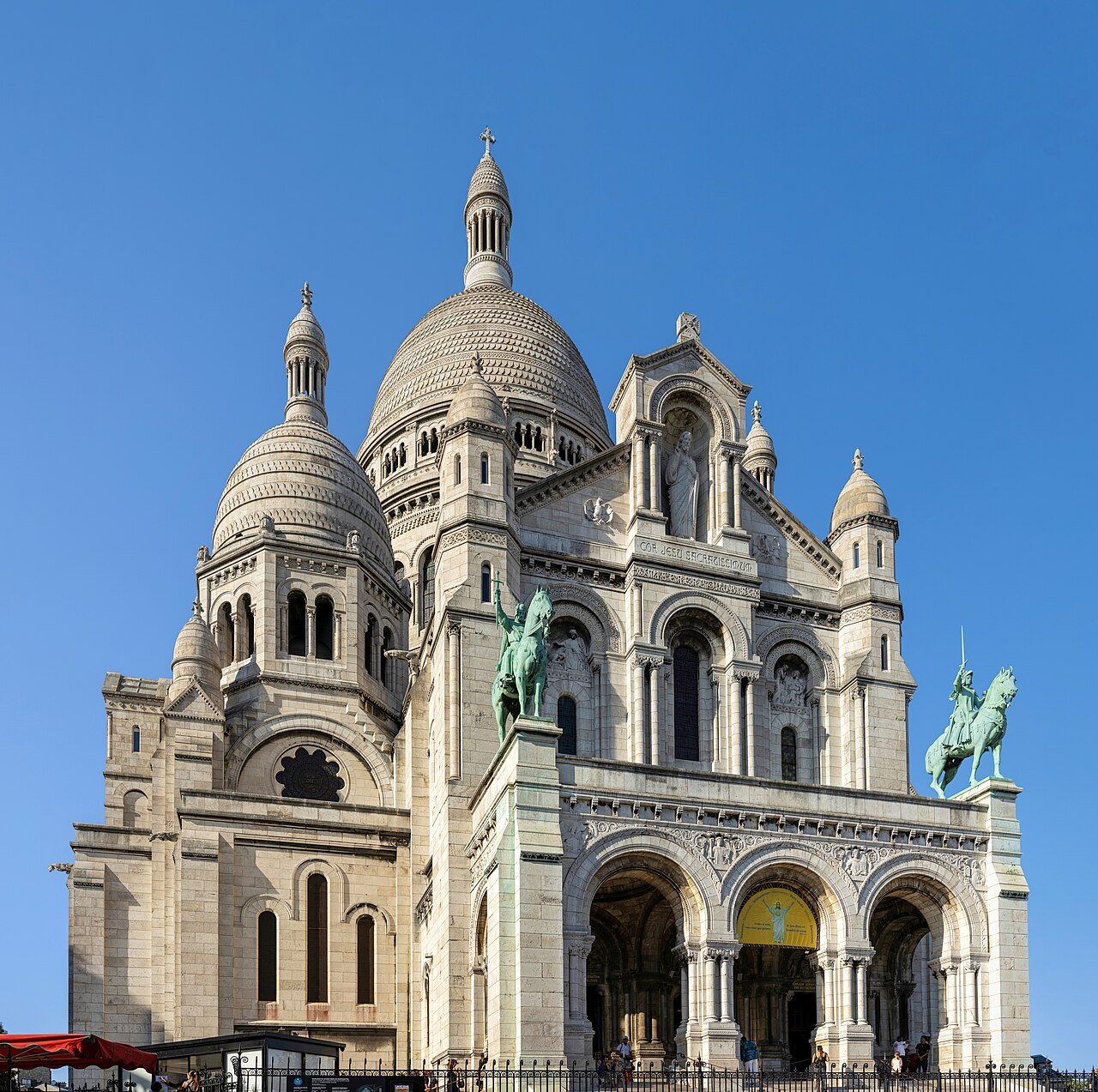
That self-cleaning quality is why the domes stand out from almost anywhere in the city. Seen from across the Seine, from a bridge, or from the steps below Montmartre, the basilica glows pale against the gray roofs and darker stone of the rest of Paris. The same weather that stains ordinary limestone over time keeps Sacré-Cœur looking almost new more than a century after it was finished.
No maintenance crew keeps the stone this color; the chemistry does the work on its own, through every rainfall, without scaffolding or cleaning visible to visitors. It is one of the few monuments in the city whose signature feature required no intervention after construction, only the right choice of stone and the passage of time.
A Church Built in Argument
The basilica exists because of defeat as much as devotion. France's loss to Prussia in 1870, and the capture of Napoleon III at Sedan, convinced its promoters that the nation was being punished for moral decline since the Revolution. They proposed a great new church in Paris dedicated to the Sacred Heart of Jesus, to be paid for entirely by private donations, and the National Assembly declared it a work of national interest in 1873.
Montmartre was chosen partly for its height, which made a new church visible across the city, and partly for its sacred associations. By tradition it is the hill where Saint Denis, the patron saint of Paris, was martyred, and where Ignatius of Loyola and his companions took the vows in 1534 that founded the Jesuits.
But Montmartre was also where the uprising of the Paris Commune began in 1871, an uprising that ended in bloody repression. For much of the political left, a church of penance built on that same hill looked like a deliberate provocation, and the argument has never entirely faded. Parliament tried to halt the project in 1882, and Clemenceau tried again in 1897; both attempts failed, largely because canceling the work would have meant repaying millions of donors.
Raising the Basilica
A competition for the design drew seventy-seven entries. Paul Abadie's plan, inspired by Romanesque and Byzantine churches, was chosen, and the cornerstone was laid on the sixteenth of June, 1875. The hill turned out to be riddled with old gypsum quarries, so before any wall could rise, builders had to dig eighty-three shafts, each about a hundred feet deep, and fill them with stone and concrete to serve as pillars under the church.
Abadie died in 1884, soon after the foundations were finished, and five more architects followed him in turn, each adjusting his plan. The interior opened for worship in 1891, the great dome was completed in 1899, and the bell tower rose in 1912, each stage visible in the slightly different style of the stonework above.
The church itself was declared complete in 1914, but the outbreak of war delayed its consecration until 1919, nearly half a century after the project began. By Paris standards, this makes Sacré-Cœur a young building, finished a quarter of a century after the Eiffel Tower, though it sits above a hill with a far older history.
What You See Outside
Over the main porch, two bronze horsemen guard the entrance: Joan of Arc and King Saint Louis, both tied to the basilica's themes of national penance and French sanctity. The white stone frames them cleanly against the sky, one of the details worth pausing over before heading inside to the dim nave beyond.
The bell tower holds the Savoyarde, the largest bell in France, weighing more than eighteen tons. It was cast in 1891 in Savoy, a gift from its dioceses, and hauled up the hill by a team of twenty-eight horses in 1895. It rings only on the great feasts of the church, though it rang once outside that schedule, on the night of the twenty-fourth of August, 1944, to announce the arrival of the first French troops in Paris at the Liberation.
The dome itself can be climbed by a long spiral stair to a gallery that opens onto a panoramic view of Paris spread out to the south, a different and higher vantage point than the one from the steps below. The climb involves a considerable number of stairs, with no shortcut partway up.
Myths Worth Setting Aside
Sacré-Cœur looks timeless on its hill, framed by Montmartre's older streets and the ancient church of Saint-Pierre nearby, but it is not an old building itself. It was begun in 1875 and only finished in 1914, consecrated in 1919, a full quarter of a century after the Eiffel Tower had already risen across the river.
Nor is its whiteness the result of a cleaning program. Visitors often assume that maintenance crews keep the stone so pale, but the travertine itself does the work, releasing calcite each time it rains and refreshing its surface without any scaffolding, chemical treatment, or scrubbing by hand, day after day.
The two facts are connected. Because the basilica is relatively young, its stone has not had the centuries that older Parisian limestone has had to darken with city grime, and because the stone keeps renewing its own surface with every rainfall, it may never darken the way older buildings nearby eventually did.
Visiting Montmartre
From the Anvers Métro station, walk up toward the foot of the hill, then either climb the two hundred twenty-two steps of the Rue Foyatier or take the funicular that runs alongside them from the Place Saint-Pierre. Arrive early in the day for the quietest steps and the clearest light over the city, before the crowds and the midday haze settle in.
The steps fill up on fine afternoons, so keep bags closed as in any crowd, and use the same care with belongings that applies anywhere in Paris. Behind the basilica lies the old village of Montmartre, with the Place du Tertre, once the site of the town hall of the commune of Montmartre, where painters still set up their easels among the café tables.
The other church on the hill, Saint-Pierre de Montmartre, is far older than the basilica beside it, a church dating from 1147 that once belonged to the abbey of Montmartre. At the end of the nineteenth century, when rents on the hill were low, painters crowded into its streets and studios; Renoir painted his Bal du moulin de la Galette here, and Picasso painted Les Demoiselles d'Avignon in the studio building known as the Bateau-Lavoir.
The house on the Rue Cortot where Renoir once rented space is now the Musée de Montmartre, and a small vineyard on the Rue Saint-Vincent still makes wine from the hill. The Moulin Rouge stands at the foot of the hill, on the Boulevard de Clichy. For planning a day that fits Montmartre alongside other sights, see itineraries and neighborhoods.
Read next
More from the journal
- The Eiffel TowerHow was the Eiffel Tower built in two years?How Gustave Eiffel's engineers raised the tallest structure in the world in just over two years.Read the piece →
- The LouvreWhy did the glass pyramid at the Louvre cause such a fight?How I. M. Pei's glass pyramid divided opinion at the Louvre, and what problem it actually solved.Read the piece →
- The Musée d'OrsayHow did a railway station become the Musée d'Orsay?How a Belle Époque railway terminus on the Seine became the world's great home of Impressionist painting.Read the piece →